Suzuki DR 125
And Their Children After ThemThe Suzuki DR 125 is the motorcycle Hacine Bouali buys despite his household’s financial difficulties, then lends to Anthony Casati during their unexpected reunion. More than transportation, it becomes a means of flight and a catalyst: its speed briefly frees Hacine from domestic tension, while its engine and familiar summer roads draw Anthony toward both an old attachment and the valley he cannot leave behind.
Purchase and Domestic Pressure
Hacine acquires the Suzuki DR 125 after a salesman at the store where he works advertises his own motorcycle for sale. Hacine goes to see him and writes a check immediately, without first considering the consequences. The purchase is striking not because the motorcycle is presented as a practical necessity, but because the family is already under financial pressure and cannot afford a vacation. They no longer have a garage, either, and Coralie fears the danger of motorcycles. Her anger gathers these material concerns into a larger question about Hacine’s maturity.
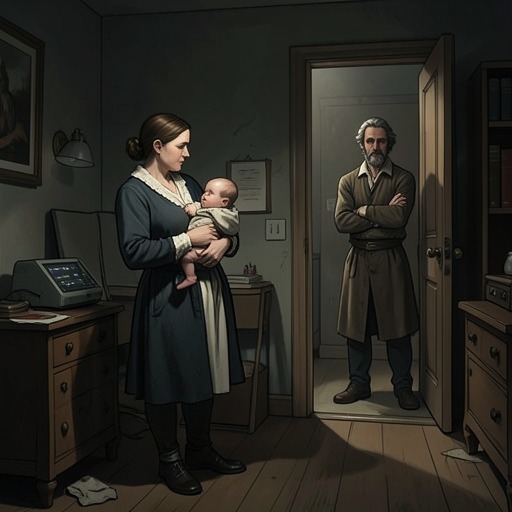
The argument takes place in the unsettled routines of life with their baby, Océane. Coralie is exhausted and struggling with changes to her body and daily life; the baby tears pages from a La Redoute catalog while the adults confront debt. Coralie has recently been asked by her parents when they will repay the money they owe. Hacine has little to say in response. The motorcycle therefore enters a household where money is already owed and ordinary plans, including a holiday, have been curtailed. His purchase does not resolve that pressure; it becomes the immediate occasion for it to surface.
Hacine later takes the bike out for a ride. The pale sky, his nervous shifting through the gears, and the near-empty tank mark the ride as an attempted departure with practical limits: he has not brought his credit card and must turn back before ten. When Coralie asks whether he is happy, the baby is asleep and he answers that he is. The scene leaves that answer in tension with his earlier realization that Océane has not relieved the unhappiness and rage he carries. The Suzuki offers movement, but not a cure for the dissatisfaction that sends him riding.
Hacine Lends the Motorcycle
During a later night in Heillange, Anthony asks to try Hacine’s motorcycle. The model is identified as a Suzuki DR 125, and Anthony laughs at the answer, finding the scale of what he has been asking for unexpectedly funny. He presses his request, explaining that his cousin has left him with a three-mile walk home. Hacine eventually agrees, in part because he feels proud of the bike.
At first Hacine sets a clear limit: Anthony is to ride to the end of the parking lot and return. Anthony asks again at a red light and promises to be careful, but Hacine refuses. When Anthony holds out his hand, however, Hacine searches his pockets and tosses him the key. The loan turns a guarded encounter into a moment of trust, although it is trust with stated boundaries rather than an open-ended permission to ride wherever he wishes.
Anthony exceeds those limits. He accelerates hard, makes a wheelie, and rides toward Hacine at high speed, circling close enough to frighten him. Hacine runs after him and calls for him to come back; Anthony continues the display before finally riding away. Their encounter shifts rapidly from joking insistence to threat and defiance, with the motorcycle giving Anthony the means to turn a short test ride into a contest of control. The bike is not merely passed between them: who holds its key, sets its limits, and controls its movement becomes part of the encounter’s tension.
Anthony’s Ride and the Road to Stéphanie
After leaving Hacine, Anthony takes the road to Stéphanie’s home without stopping to think. His heart is pounding, and he arrives at the Chaussoy house, whose size and carefully kept grounds make the visit feel different from the casual ride he had requested. The Suzuki has carried him from an encounter with Hacine toward a place associated with his unresolved attraction to Stéphanie. The narrative does not describe the motorcycle as deciding for him; rather, its immediate availability makes possible the impulsive turn he takes.
On another evening, Anthony rides the Suzuki from the garage after speaking with his mother, Hélène. He has decided to return the motorcycle to the Darty where Hacine works, leaving it outside and putting the keys in the mailbox. This is his plan, not an outcome the passage confirms. Before setting out, he packs tumblers, rosé, chips, and a chocolate bar in his backpack. He then rides through the woods toward a meeting with Hélène at the beach, feeling free despite the circumstances. The sequence puts his intention to relinquish the bike beside the renewed pleasure of riding it.
At the beach, Hélène asks what motorcycle he has brought. Later, as two young people swim toward open water and the others remain ashore, Anthony chooses not to watch. He climbs back onto the Suzuki and reaches the departmental highway. The motorcycle takes him away from the group and into the familiar summer landscape. The ride’s importance lies in this change of direction: a machine Hacine bought amid conflict has become Anthony’s route out of a scene he does not want to witness.
Speed, Memory, and Belonging
For Anthony, the Suzuki’s engine and vibration are bound to the bodily memory of wanting to ride. During the night journey with Hacine behind him, the small motor and the wind bring back old memories and renew his desire to drive. Once he has the key, that desire becomes action: he accelerates, tests the motorcycle’s response, and experiences an exhilaration that makes the parking-lot ride feel far larger than its limited setting. The narrative’s focus on the machine’s noise and movement makes the physical act of riding central to the episode rather than a neutral transition between locations.
The final ride gives that attachment a different meaning. Anthony registers the Suzuki through its vibration, noise, and exhaust as he moves onto the highway, while the July light, woods, wind, and road recall impressions he associates with Heillange. The familiarity of the landscape is described as something imprinted on him; the motorcycle carries him through it, making motion and rootedness coexist. He can leave the beach and travel quickly, yet the ride renews the valley’s hold on him. In that contrast, the Suzuki becomes the story’s instrument of temporary freedom and its reminder that belonging can be both painful and difficult to escape.